

Why Care About The Murray-Darling Basin?
It's Long
The world's 15th longest river system, longer than the Zambesi in Africa.
And It's Big
Bigger than France. The waterways flow from highlands, such as Kosciuszko National Park and the Great Dividing Range in Southern Queensland, but all of the Basin’s tributaries end up in the one location: at the mouth of the Murray River in South Australia.
We Depend On It
It’s Australia’s food bowl. The Murray-Darling Basin is where 40 per cent of Australia’s agricultural production happens.
The Basin also carries great significance for many Aboriginal nations. There are more than 10,000 Aboriginal sites in the Basin area, including sacred sites and burial grounds.
In 2005 the Murray, with its wetlands, national parks, state forests and wineries, added $1.6 billion to the Australian economy. 3
Percentage of Australia's production in the Murray-Darling Basin — 2005-06
But it is fragile
The river exists on a knife edge. The Basin loses a whopping 94 per cent of its rain to evaporation each year. This is extraordinary; the Indus Basin, which covers a similar area across parts of India and Pakistan, loses just 10 per cent to evaporation. 3
Of the average 530,618 GL of rainfall, 94% is lost through evaporation
This leaves just 6% for the river systems


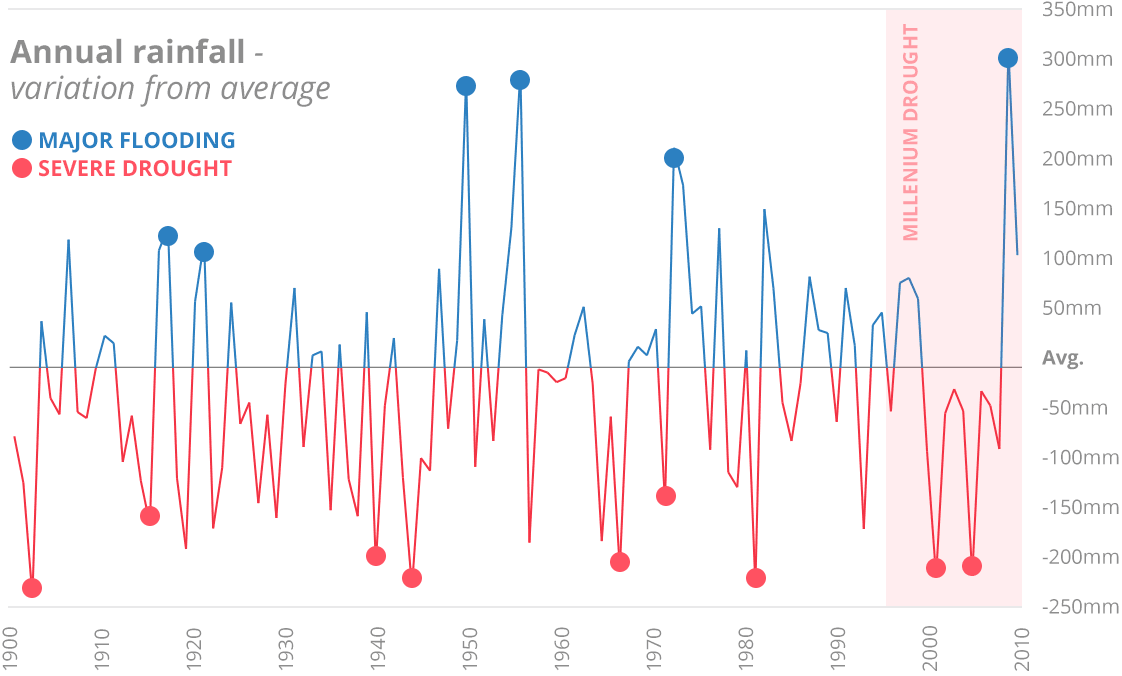
Rainfall in the Basin is also wildly unpredictable, so conditions on the ground are extreme, often it’s either flood or drought.
Crops Cotton socks and laser beams

54.5% Approx.
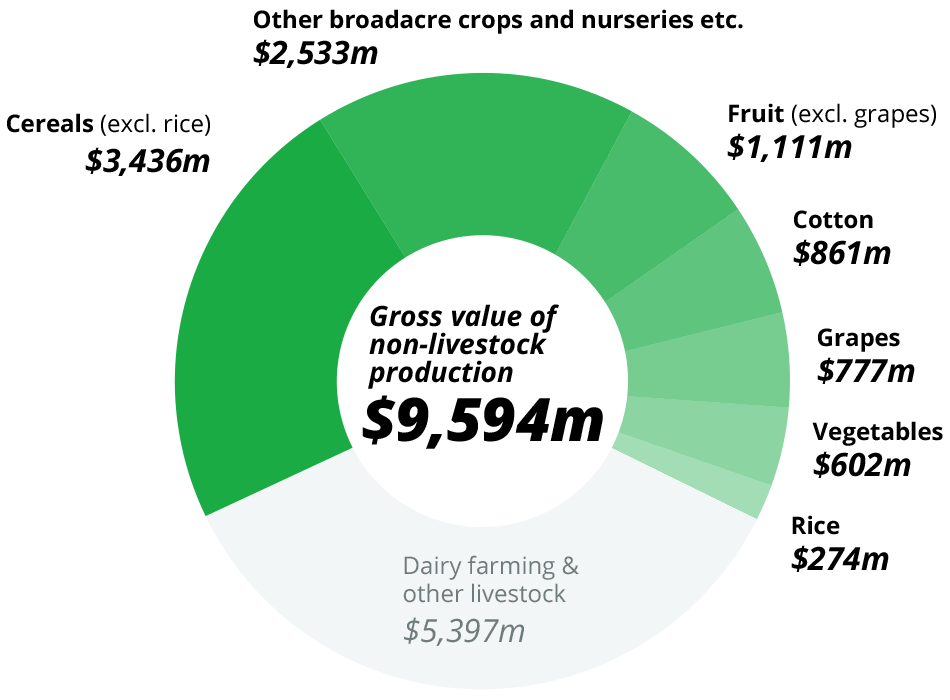
Over the years farmers have carved out canals and levees to extract water from the rivers; the majority of the Basin’s water is used for crops. Planted crops alone were worth more than $9.5 billion in 2005-06.
Gross value of agricultural production in the Murray-Darling Basin — 2005–06
Laser-guided farming
Farmers use sophisticated technologies to get the most out of the water. Satellite farming — data gathered via satellite mapping — can show a farmer the level of soil moisture in a paddock a half-hour's drive away, at a click of a button.
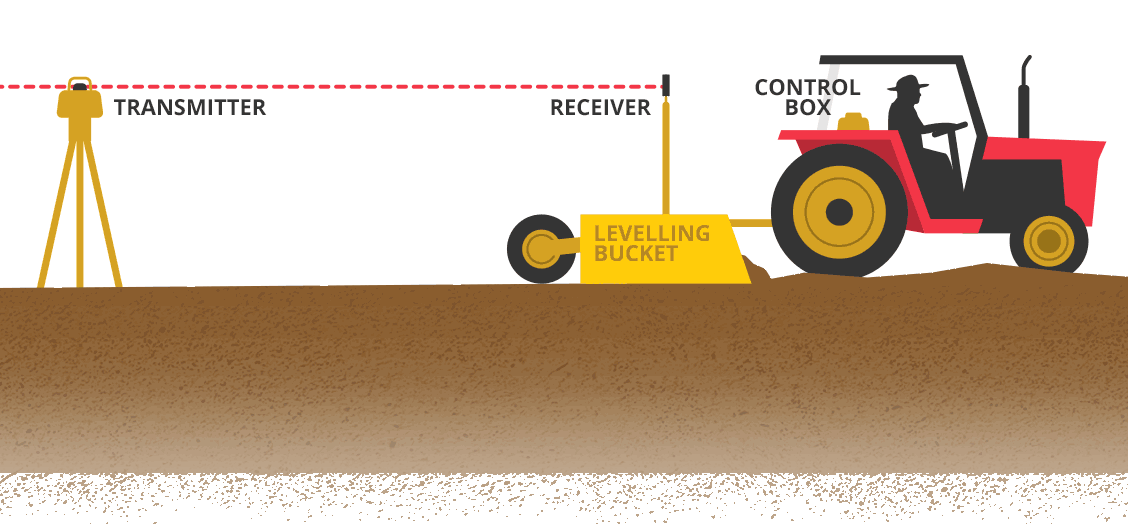
Rice farmers use a laser-guided system to create a minute slant on each paddock, so a smaller amount of water can flow across, get to the end, and be pumped back to the top for reuse.3
How laser levelling works
The transmitter emits a laser beam as a reference point
The beam is read by the receiver and passed to the control box
The control box interprets the signal and adjusts the position of the levelling bucket to grade the field at the desired angle
Fields are graded at a very slight angle to enable the water to flow down at the most efficient rate.
Controversial cotton
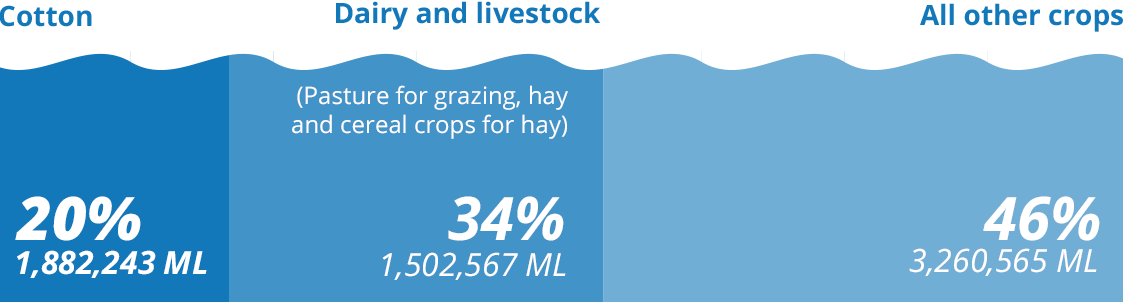
The cotton crop consumed about 20 per cent of all irrigated water from the Basin over the past decade, yet contributed just 6 per cent of the Basin's production in dollars, based on sample year 2005-06. 3
Proportional water use for cotton in the Murray-Darling Basin — 2005-06
Proportional gross value of cotton in the Murray-Darling Basin — 2005-06

Livestock & Dairy Wooly jumpers and your morning coffee
27.5% Approx.
Australia built its economy “on the sheep’s back” and still commands more than a quarter of the world’s wool trade.
The Basin has 45% of the nation’s sheep stock (including meat stocks)

Where does your latte come from?
One-third of Australia’s dairy cows in Australia live on the Murray-Darling Basin plains. If you’re sipping in NSW or Victoria, it’s highly likely to be from a Basin cow.
Thirsty stock
Lots of water is used for farming livestock — particularly when rainfall doesn’t support decent pasture growth. The Basin supplies 44 per cent of Australia’s hay for livestock. 3
Highest water use for agriculture in the Murray-Darling Basin — 2010–11
Water buying back-wards & forwards
Australia is the driest continent in the world, and water is a feverishly traded commodity. As most farmers cannot rely on regular rainfall, they are supplied by irrigation channels from the Basin.
A water-trading system, formalised in the early 20th century, manages distribution of the commodity in competing regions with “The Cap” — a variable limit on water use. Farmers get a percentage, instead of a set amount, of annual water.
Farmers can hold onto their permanent water allocations while trading temporary entitlements from year to year. For example, in times of drought rice farmers can choose not to plant their rice crop and instead sell their water allocations to farmers who have a long-life crop, such as fruit trees, so they still have an income.
Volume of water traded in the southern MBD — 2008-09
The rest... Is the glass half full?
18% Approx.
Most of the remaining Murray-Darling Basin water is used for mining and other industries, consumed as drinking water, and simply lost during transportation. Local mining consumes a relatively small percentage of Basin water, but there are concerns about its effect on the health of the river system. 3
They must put something in the water around here
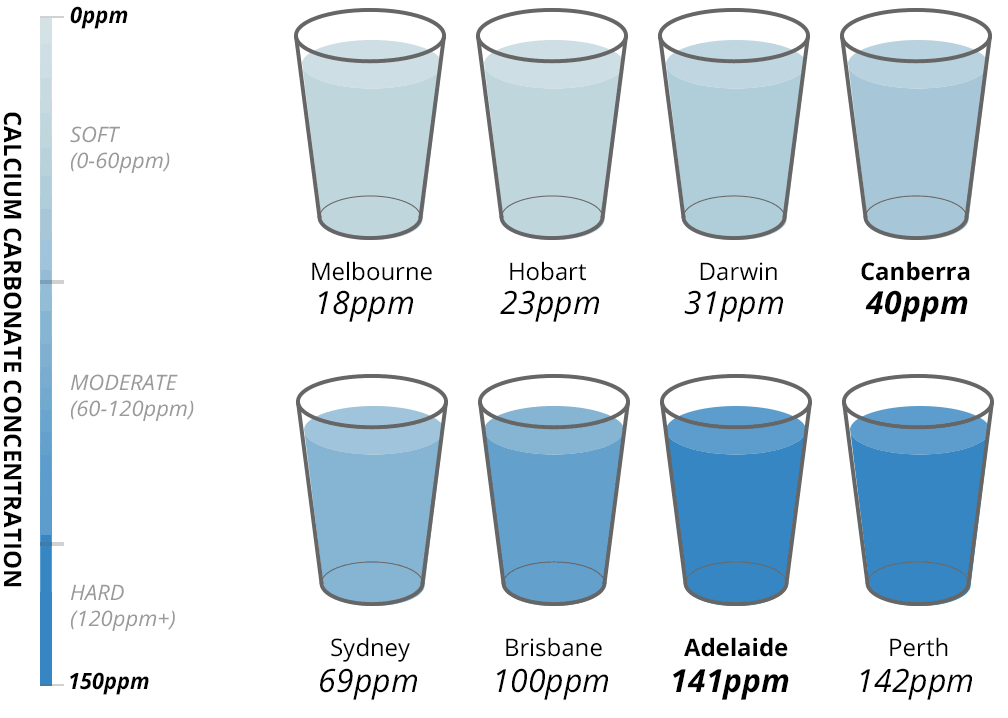
More than 3 million people rely on the Basin for drinking water. Canberra sources its water at the clean, upper end of the system, from subsidiaries of the Murrumbidgee river. Adelaide gets its water from the end of the Murray. A good gauge of the taste of the water is to measure the concentration of calcium carbonate in the drinking water. Higher levels of calcium carbonate mean that the water is ‘hard’ and has a strong mineral taste, whereas ‘soft’ water tastes flatter, or, most would say, better. 3
Water hardness in Australian cities
Retaining water
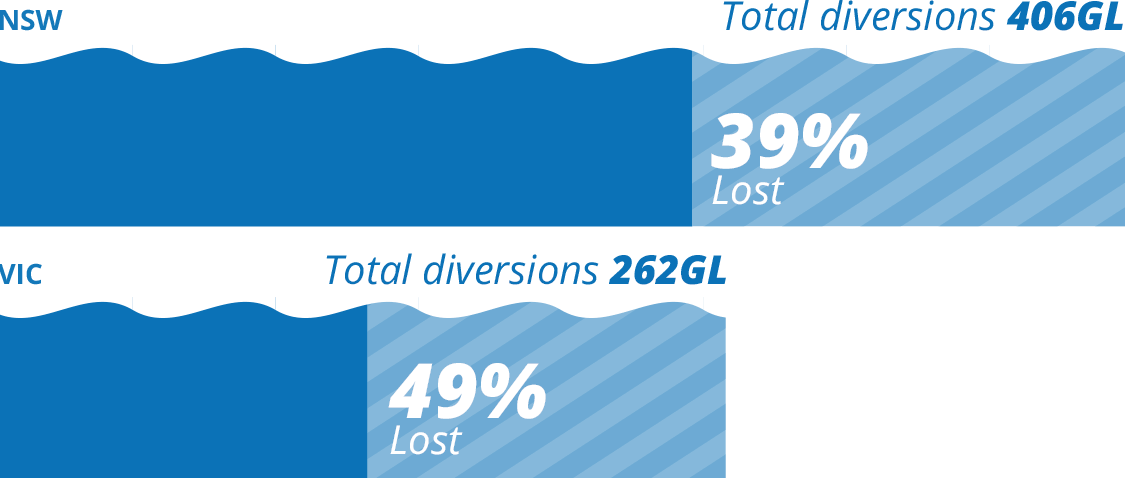
A large amount of water is ‘wasted’ during its journey to farms — either through evaporation or seeping away through a canal bank, flooded over the banks, or lost in various irrigation infrastructure weak spots. But environmentalists argue that this ‘lost’ water actually performs important environmental functions where it returns to the environment. 3
Diversions and losses in the Southern Murray-Darling Basin — 2007-08
What’s left for the environment?
A 2008 report showed the Murray-Darling Basin rivers have been severely compromised.
Water allocation has put severe pressure on farmers, and left large areas at the mercy of drought.
Even the iconic river red gums are dying of thirst all over the Basin.
Farming fertilisers, chemicals and manure from livestock grazing collect in the river system, increasing nutrients, which can lead to side effects such as blue-green algae that can bloom uncontrollably, poisoning the water.
And farmland has often been cleared right up to the river banks, damaging the ecosystem of the river, removing from the riparian zone vital trees and shrubs that help maintain river health. Land clearing has also caused the water table to rise, increasing the risk of salinity.
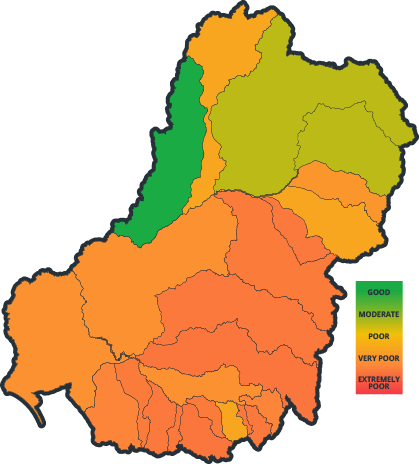
Ecosystem Health assessments by Valley — Murray Darling Basin 2004-07
Salty situation
Australia is naturally salty, and the river system is a cleanser.
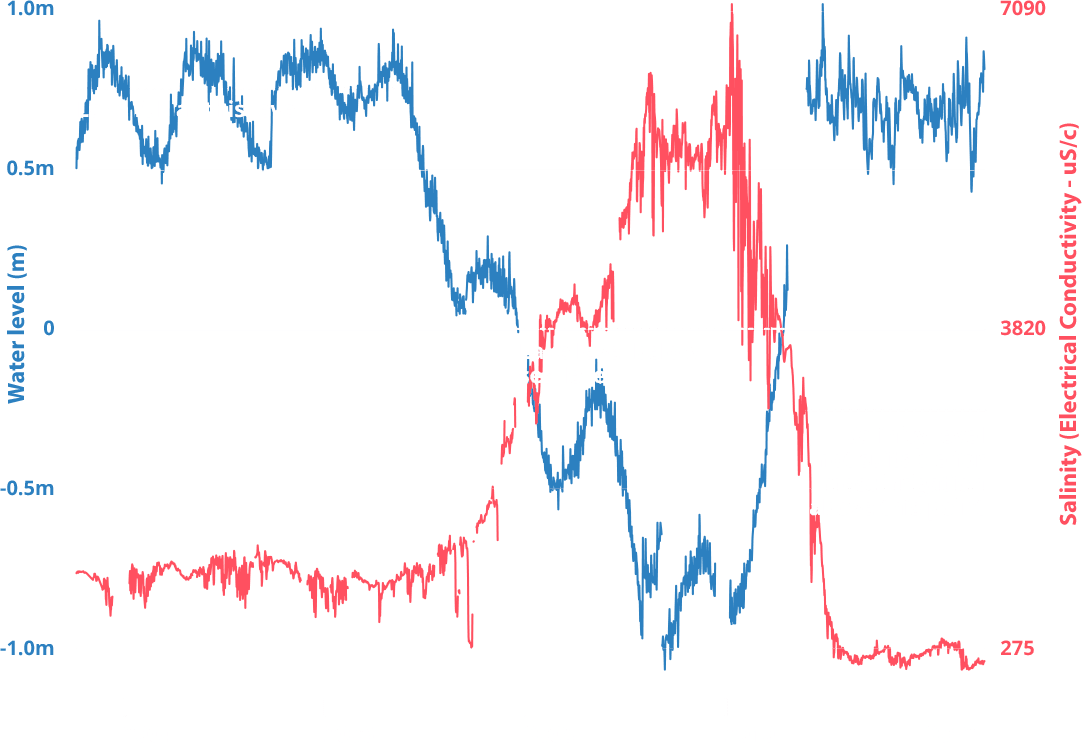
In the so-called Millennium drought — between 1995 and 2012 — the mouth of the Murray in South Australia almost completely dried up. The southern lakes at their driest dropped to 1.5 meters below sea level.
With high salinity comes death; livestock can’t drink, plants wither and die. 3
Water and salinity levels — Lake Alexandrina, Lower Murray Darling Basin
Cod’s sake
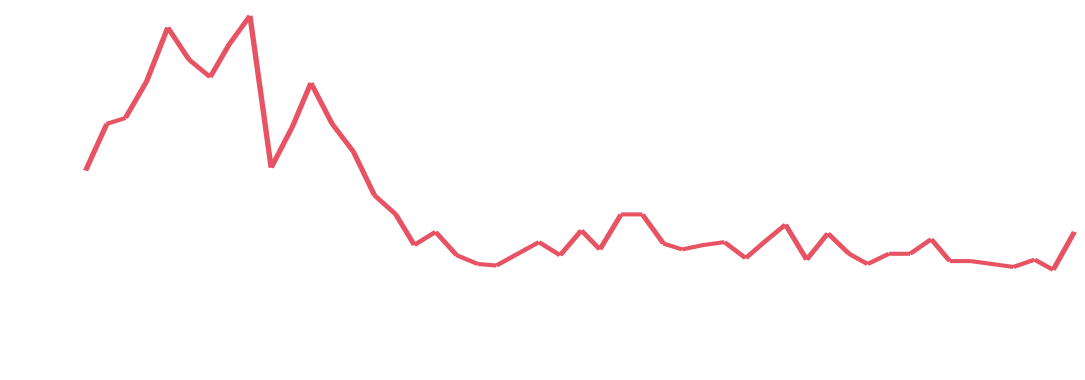
The Murray Cod is a freshwater fish vulnerable to rising salinity and sometimes isolated in stagnating pools as water dried up; the fish has been in decline for some time. Murray Cod was listed as a vulnerable species under the conservation act in 1999 due to an estimated 30 per cent decline over the past 50 years.
The fish across the Murray-Darling Basin are suffering, with native fish outnumbered in most areas by alien species.
Total catch of Murray cod 1947–48 to 1995–96
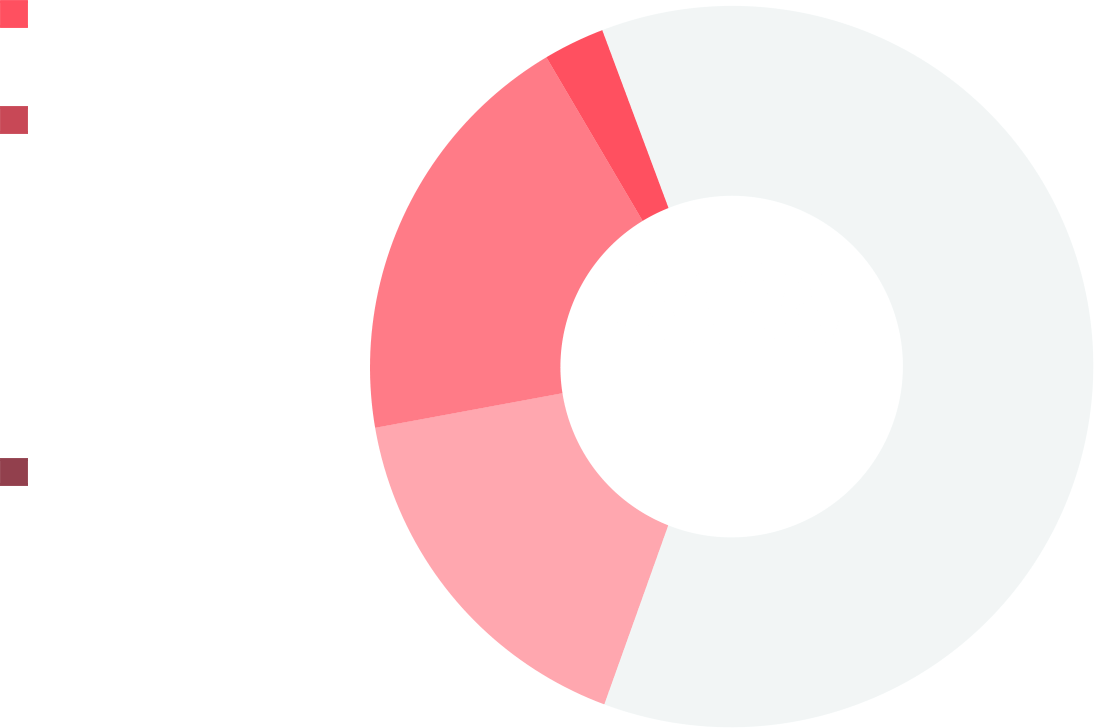
Threatened native fish species in the Basin — Listed as endangered, vulnerable or protected (State or Commonwealth)
The future
The Murray-Darling Basin Plan, signed into law near the end of 2012, will spend $11.5 billion to try and fix the system. It includes a water return target of 3,200GL.
But is the plan enough – can this river system be saved?